
A refrigerator compressor that is not running has four possible causes — listed from most common to least: a failed start relay ($10–25, DIY fix), a tripped overload protector (resolves by cooling down and waiting), a failed temperature control or control board error (reset or replace), or a failed compressor (requires professional repair). The start relay accounts for the majority of compressor non-starts and should always be the first component checked.
What causes a refrigerator compressor to stop running
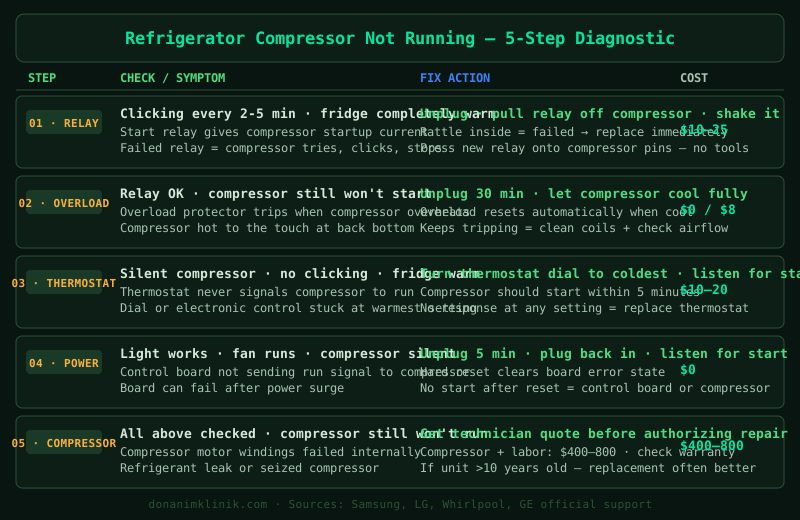
Failed start relay — The start relay is a $10 to $25 part that clips onto the compressor and provides the initial burst of power the compressor needs to begin each cooling cycle. When the relay fails, the compressor cannot start. The symptom is distinctive: a clicking sound every 2 to 5 minutes as the system attempts and fails to start the compressor. The rattle test — shaking the relay and hearing a rattle inside — confirms failure in 10 seconds.
Tripped overload protector — The overload protector is a thermal switch that cuts power to the compressor when it overheats. It resets automatically after the compressor cools, which is why some refrigerators work again after being unplugged for a period. The root cause of repeated overload trips is usually dirty condenser coils preventing heat dissipation.
Thermostat or control board not signaling — The compressor only runs when the thermostat or control board sends it a run signal. A failed thermostat that is stuck in the ‘satisfied’ position, or a control board locked in an error state, will keep the compressor silent even though all components are mechanically sound.
Compressor failure — Internal motor winding failure, mechanical seizure, or refrigerant loss can all cause a compressor to stop running permanently. This requires professional diagnosis and repair because it involves the sealed refrigerant system.
How to fix refrigerator compressor not running
Always start with the start relay check (Step 1). It is the most common cause, the least expensive fix, and takes under 10 minutes. Do not skip directly to the compressor failure conclusion — the majority of refrigerators brought to repair shops for “compressor failure” are resolved by a start relay replacement.
How to verify the fix
After replacing the start relay and plugging the refrigerator back in, listen at the back of the unit within 5 minutes. You should hear the compressor start — a low hum that continues for 8 to 15 minutes. The refrigerator and freezer sections will not return to temperature immediately: allow 4 to 8 hours for the refrigerator to reach 37°F and the freezer to reach 0°F. If the compressor starts but stops again within hours, the overload is tripping due to dirty coils — clean the condenser coils before the next restart.
Step-by-step fix
Check and replace the start relay
The start relay is a small component that clips directly onto the side of the compressor. It provides the surge of electrical current the compressor needs to start each cooling cycle. When the relay fails, the compressor cannot start, cooling stops completely, and you typically hear a clicking sound every 2 to 5 minutes as the compressor attempts to start and fails. To diagnose: unplug the refrigerator and pull the unit away from the wall. Locate the compressor at the bottom rear — it is a black, dome-shaped or cylindrical metal component. The start relay is a small box or plug clipped onto the compressor pins. Pull it straight off. Shake it next to your ear. A rattling sound inside confirms the relay has failed. Contact an appliance technician with this diagnosis — start relay replacement is a quick $80 to $150 service call including parts.
Allow the compressor overload protector to reset
The compressor has a built-in overload protector that trips and cuts power to the compressor when it overheats. This is a safety mechanism, not a failure. A compressor overheats from extended running in high ambient temperatures, dirty condenser coils that prevent heat dissipation, or a refrigerant charge issue. Symptom: the compressor is hot to the touch at the back bottom of the refrigerator and is silent. To reset: unplug the refrigerator and leave it unplugged for 30 minutes with the doors open or at least partially ajar. This allows the compressor to cool and the overload protector to reset automatically. After 30 minutes, plug the refrigerator back in and listen for the compressor to start. If it starts and runs normally, clean the condenser coils to prevent recurrence. If the overload trips again within a few hours, the compressor itself is failing or the condenser coils are severely fouled.
Turn the temperature control to the coldest setting
If the compressor is completely silent — no clicking, no hum — the thermostat or temperature control may not be calling for cooling. This happens when the temperature control dial is set near 'Off', when the temperature setpoint is very warm (and the refrigerator has already reached that temperature), or when the thermostat has failed in the 'no-call' position. Turn the temperature control dial to the coldest setting. Within 5 minutes, the compressor should start with a low hum. If the compressor starts, the thermostat was set too warm or has a contact issue at specific dial positions. If no start occurs at the coldest setting, the thermostat has failed or the control board is not delivering the run signal.
Hard reset the control board
Modern refrigerators use an electronic control board to manage the compressor, fans, and defrost system. A power surge or firmware error can leave the board in a state where it does not send the run signal to the compressor even though the display and lights work normally. To hard reset: unplug the refrigerator for 5 full minutes, then plug it back in. Listen for the compressor to start within 5 minutes of restoring power — the board runs startup diagnostics after a hard reset and should initialize the compressor. This resolves control board lockup without requiring any parts. If the compressor starts after the reset but stops again within hours, the board may have a deeper fault and need replacement ($50 to $200 depending on model).
Confirm compressor failure and get a repair quote
If the start relay is good (no rattle), the overload protector has been allowed to reset, and the hard reset did not restore operation, the compressor itself has failed. A failed compressor shows one of three conditions: completely silent with no attempt to start, a loud hum that lasts several seconds then cuts off (motor winding failure), or a grinding or knocking sound when it attempts to run (mechanical failure). Compressor replacement requires a certified technician because it involves handling refrigerant — a sealed system repair that cannot be done DIY in most jurisdictions. Typical cost for compressor replacement is $400 to $800 including labor and refrigerant. Before authorizing repair: check whether the refrigerator is still under the manufacturer warranty (LG extended linear compressor warranty to 7 years in 2022; Samsung offers a 5-year sealed system warranty on some models) or a home warranty plan.