
Samsung freezer temperatures above 0°F (-18°C) are caused by a small set of fixable conditions — the temperature set too warm, dirty condenser coils reducing system efficiency, a door gasket that is no longer sealing, or partial ice buildup on the evaporator coils. Samsung’s own documentation identifies 0°F as the correct setpoint for all models, and all temperature-related issues should be confirmed with a thermometer inside the freezer rather than relying on the display, which shows the target setpoint rather than the actual temperature.
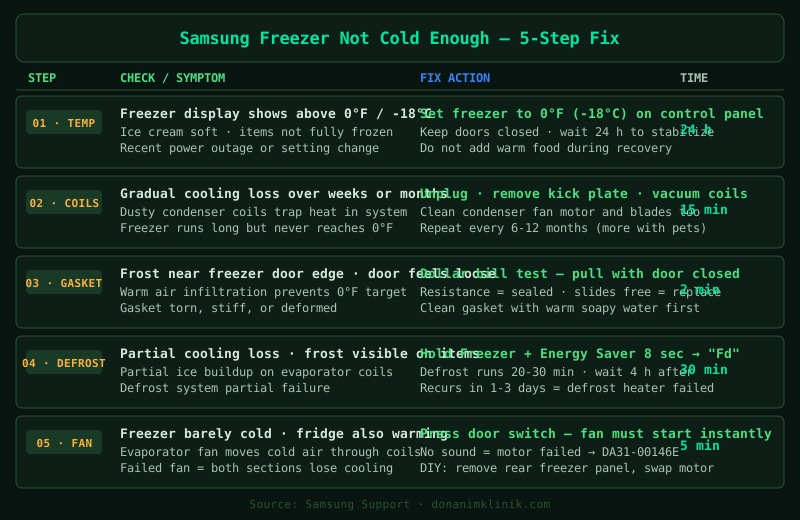
What causes a Samsung freezer to not be cold enough
Incorrect temperature setting — The most common and easiest cause. Samsung freezers are set at the factory to 0°F (-18°C), but settings are sometimes changed during a move, after a power outage, or accidentally when cleaning the control panel. The display shows the target setpoint, not the measured temperature — verify the actual temperature with a thermometer.
Clogged condenser coils — Located behind the kick plate at the bottom front of most Samsung refrigerators, condenser coils are responsible for releasing heat from the refrigerant. When they accumulate dust and pet hair over months or years, their ability to release heat declines. The result is a freezer that runs constantly but cannot reach its target temperature.
Door gasket failure — The gasket creates an airtight seal when the freezer door is closed. A torn or deformed gasket allows warm, humid room air to continuously enter the freezer. This raises the temperature, causes frost to form near the door edges, and forces the compressor to run almost continuously. The dollar bill test identifies gasket failure without tools.
Partial evaporator ice buildup — Unlike a complete freeze-over (which stops all cooling), partial ice buildup on the evaporator coils reduces airflow and heat exchange, causing the freezer to run 5 to 15 degrees above the setpoint. Forced defrost clears the ice; persistent recurrence means the defrost heater or defrost thermostat has failed and needs replacement.
How to fix Samsung freezer not cold enough
Work through the steps in sequence. Start with the setpoint check and thermometer reading before moving to mechanical causes — many Samsung freezer temperature complaints are resolved by confirming the setpoint and waiting 24 hours with the door kept closed.
How to verify the fix
Place a refrigerator thermometer in the center of the freezer. After 24 hours with the door kept closed, the reading should be at or below 0°F (-18°C). A reading between 0°F and 5°F indicates normal acceptable variation. A reading above 5°F after 24 hours confirms a mechanical issue — proceed to check condenser coils and door gasket. If the thermometer shows 0°F but ice cream is still soft, the thermometer may be inaccurate — try a different thermometer before concluding there is a mechanical problem.
Step-by-step fix
Set the freezer to 0°F (-18°C) and wait 24 hours
The Samsung freezer's target temperature is 0°F (-18°C). At temperatures above 10°F (-12°C), ice cream softens and food begins to lose frozen texture even though the freezer feels cold. Check the temperature setting on the control panel and confirm it is set to 0°F (-18°C). If the display shows a higher setting, adjust it down. After making the change, keep the freezer door closed for 24 hours — opening the door repeatedly prevents the freezer from stabilizing at the new setpoint. Do not add large quantities of room-temperature or warm food during this period. Check the actual temperature with a freezer thermometer after 24 hours to confirm the setpoint has been reached.
Clean the condenser coils
Condenser coils release heat from the refrigerant to the room. When coils accumulate dust, the system cannot reject heat efficiently and the freezer struggles to maintain 0°F — it runs continuously but cannot reach target temperature. On most Samsung refrigerators, condenser coils are behind the kick plate at the bottom front of the unit. Unplug the refrigerator before cleaning. Remove the kick plate (it snaps off on most Samsung models) and use a vacuum cleaner with a brush attachment to remove dust from the coils and the condenser fan blades. This step takes 15 minutes and can recover several degrees of cooling when coils are heavily fouled. Samsung recommends cleaning every 6 to 12 months.
Inspect the freezer door gasket
The freezer door gasket must seal completely to maintain 0°F. A torn, warped, or stiff gasket allows warm room air to infiltrate continuously, which raises the freezer temperature and causes frost buildup near the door edges. To test: close the freezer door on a dollar bill or sheet of paper. You should feel clear resistance when pulling the paper out. Test around the full perimeter of the door. If the paper slides out easily at any point, the gasket has lost its seal. Also clean the gasket with warm soapy water — a dirty or hardened gasket may seal poorly without being visibly damaged. Replacement gaskets are available by model number.
Run forced defrost to clear partial ice buildup on evaporator coils
Partial ice buildup on the evaporator coils reduces their ability to absorb heat, causing the freezer to run warmer than set. This is different from a complete freeze-over — the freezer still cools but cannot reach 0°F. On most Samsung French door and side-by-side models (2016 and later): press and hold the Freezer and Energy Saver buttons simultaneously for 8 seconds until all display segments light up. Press Freezer repeatedly to cycle through modes until 'Fd' appears. Press Freezer once more to activate. The cycle runs 20 to 30 minutes. After defrost exits, wait 4 to 8 hours for the freezer to return to temperature. If the problem recurs within 1 to 3 days, the defrost heater or defrost thermostat has failed.
Test the evaporator fan motor
The evaporator fan circulates cold air through the freezer. A failing fan motor that is weakening (not yet completely failed) can cause the freezer to run 5 to 10 degrees warmer than the setpoint while the compressor continues to operate normally. Open the freezer door and press the door switch with your finger to simulate a closed door. Listen for the evaporator fan motor behind the rear panel. A healthy fan runs at full speed when the switch is pressed. A fan that runs intermittently, sounds rough, or makes a grinding noise is failing. A completely failed fan stops the freezer from cooling at all — but a partially failing fan shows up as persistent temperature offset. If the fan is failing, contact an appliance technician — evaporator fan motor replacement (part DA31-00146E on most Samsung models) is a $150 to $250 service call including parts and labor.