
Samsung refrigerator ice makers stop producing ice for a small set of reasons — most are fixable without a service call. According to Samsung’s official troubleshooting documentation, the leading causes are the ice maker being switched off or in demo mode, the freezer temperature rising above the threshold for ice production, a clogged water filter reducing pressure below the required minimum, and the ice maker tray or fill tube freezing solid. The reset-plus-defrost approach resolves the majority of Samsung ice maker failures.
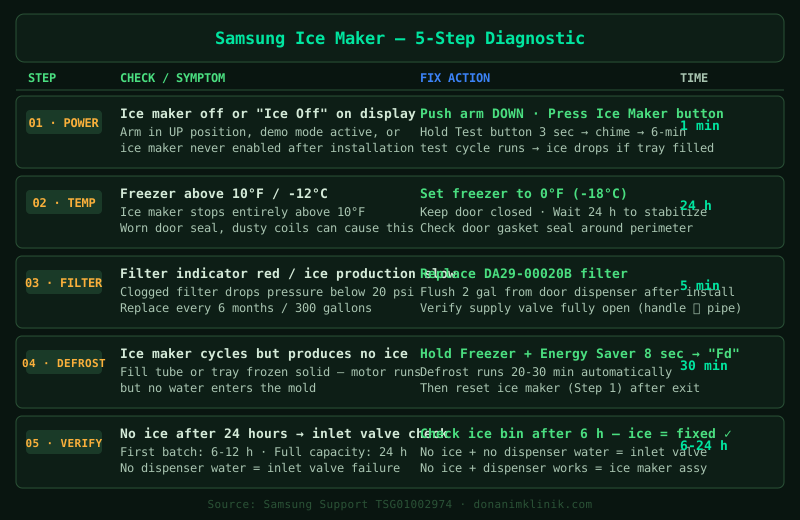
What causes a Samsung ice maker to stop working
Ice maker switched off or in demo/showroom mode — Samsung refrigerators ship with the ice maker disabled. If the ice maker was never enabled after installation, or was accidentally turned off, it will not produce ice regardless of temperature or water supply. Demo mode (which disables cooling and ice production for showroom display) can be inadvertently activated by holding certain button combinations.
Freezer temperature above 10°F (-12°C) — Samsung’s ice maker requires the freezer to maintain 0°F (-18°C) for consistent production. Above 5°F (-15°C), production slows. Above 10°F (-12°C), the ice maker stops entirely. Frequent door openings, a worn door gasket, or a condenser coil clogged with dust can all prevent the freezer from reaching the required temperature.
Water filter clogged or overdue — Samsung recommends replacing the water filter every 6 months or every 300 gallons. A clogged filter drops water pressure below the 20 psi minimum the ice maker needs to fill its tray. The filter indicator on the control panel turns red when replacement is due, but it can become overdue without triggering the indicator if the filter has partially bypassed.
Ice maker tray or fill tube frozen solid — The most common reason a Samsung ice maker cycles (you can hear the motor) but produces no ice. Water in the fill tube freezes before it reaches the ice tray, or the ice tray itself ices over due to a door seal leak allowing warm air into the freezer. Forced defrost melts the obstruction without requiring disassembly.
Water inlet valve failure — The water inlet valve at the back of the refrigerator opens to allow water into the ice maker when the fill cycle starts. If the valve solenoid has failed, no water enters the ice maker regardless of pressure or filter condition. A failed inlet valve produces a distinctive symptom: the ice maker runs its cycle, makes no ice, and the dispenser also produces no water.
How to fix Samsung refrigerator ice maker not working
Work through the steps in order. Steps 1 and 4 (reset and forced defrost) resolve the majority of Samsung ice maker failures. Step 3 (water filter) addresses cases where ice production has gradually slowed rather than stopped suddenly.
How to verify the fix
After completing forced defrost and the ice maker reset, close the freezer and wait 6 hours. Open the freezer and check the ice bin — there should be a small batch of new ice. If no ice is present after 12 hours and the freezer temperature is confirmed at 0°F, dispense water from the door to verify water supply is reaching the refrigerator. No water from the dispenser after filter replacement points to an air lock (purge 2 gallons); water from dispenser but no ice points to the water inlet valve or ice maker assembly needing replacement.
Step-by-step fix
Check the ice maker switch and reset it
Open the freezer and locate the ice maker's power switch or shutoff arm. If the arm is raised (UP position), push it down to enable production. On touchscreen Family Hub models, go to Settings > Ice Maker > Enable. To reset, press and hold the Test button on the ice maker unit for 3 seconds until you hear a chime — the ice maker runs a 6-minute test cycle and drops any ice in the tray. Do not press Test more than once; repeated test cycles delay ice production.
Verify freezer temperature is at or below 0°F (-18°C)
Samsung ice makers slow production significantly above 5°F (-15°C) and stop entirely above 10°F (-12°C). On the control panel, confirm the freezer is set to 0°F (-18°C). If the temperature display shows a higher reading, reduce it to 0°F and wait 24 hours for the freezer to stabilize. Frequent door openings, a damaged door seal, or a recently added large amount of warm food can temporarily raise the temperature — these conditions resolve on their own once the door stays closed.
Check the water filter and water supply line
A clogged water filter reduces pressure to the ice maker below the 20 psi minimum Samsung requires, stopping ice production. If the filter indicator is red or the filter has been in service longer than 6 months, replace it with a genuine Samsung DA29-00020B filter or the model specified on your filter label. After installing the new filter, dispense 2 gallons from the door water dispenser to purge air from the line. Also verify that the water supply valve behind the refrigerator is fully open — the handle must be parallel to the pipe — and that the water supply line is not kinked.
Run a forced defrost cycle to clear a frozen ice maker
If the ice maker runs (you can hear it cycle) but produces no ice, the fill tube or ice tray is likely frozen solid. Samsung refrigerators have a built-in forced defrost mode. On most Samsung French door and side-by-side models (2016 and later): press and hold the Freezer and Energy Saver buttons simultaneously for 8 seconds until the display shows 'OF' or all segments light up. Then press the Freezer button repeatedly to scroll through modes until 'Fd' appears. Press Freezer once more to activate. The defrost cycle runs for 20 to 30 minutes, then the refrigerator exits defrost mode automatically. Button combinations vary by model — if this sequence does not work, search your model number plus 'forced defrost' on Samsung's support site for the exact sequence.
Allow 24 hours and check ice production
After completing the steps above, the ice maker needs time to refill and freeze a new batch. According to Samsung's documentation, the first batch of ice appears within 6 to 12 hours after a reset or defrost. Full production capacity — up to 120 ice cubes per day depending on model — is reached within 24 hours. If the ice maker still produces no ice after 24 hours, proceed to check the water inlet valve: it is located at the back of the refrigerator where the supply line connects. A failed inlet valve does not open to allow water into the ice maker even when pressure and filter are correct — valve replacement is a common Samsung ice maker repair.