
Whirlpool refrigerators that freeze food in the refrigerator section have a small set of causes — all of which are diagnosable without a technician. According to Whirlpool’s use and care documentation, the recommended refrigerator temperature is 37°F (3°C), and food placed directly against rear vents will freeze at any temperature setting. The two mechanical causes — a stuck damper door and a failed thermistor — both have clear symptoms that allow diagnosis before ordering parts.
What causes a Whirlpool refrigerator to freeze food
Temperature set too low — The most common cause. Whirlpool refrigerators set below 35°F will actively freeze food near the air vents and cause other items to reach near-freezing temperatures. Many users set the refrigerator to a very cold setting when bringing home large amounts of groceries, then forget to return it to the normal setting.
Food placed against vents — Cold air exits the rear vents at 28 to 32°F before mixing with the compartment air. Items placed within an inch of these vents will freeze regardless of the overall compartment temperature. This is the cause when only items against the back wall are affected.
Damper door stuck open — The damper controls how much cold air flows from the freezer section into the refrigerator section. When the damper is stuck open, the refrigerator section receives continuous freezer-temperature air and drops well below the setpoint. The entire refrigerator section freezes uniformly, not just items near vents.
Thermistor failure — The temperature sensor (thermistor) that reports the refrigerator section temperature to the control board can fail by reading artificially high. When the board receives a false warm reading, it runs the cooling system continuously, overcooling the section. This typically produces an error code on the display.
How to fix Whirlpool refrigerator freezing food
Work through the steps in sequence. Steps 1 and 2 resolve most cases and require no tools. Steps 3 and 4 address component failures that require inspection and possible parts replacement.
How to verify the fix
Place a refrigerator thermometer in the center of the refrigerator section (not near vents or the door). After 24 hours with the door kept closed at normal usage frequency, the thermometer should read 35 to 38°F (1.7 to 3.3°C). A reading below 33°F confirms a mechanical overcooling problem — check the damper door (Step 3) if all food is freezing, or the thermistor (Step 4) if the display is showing an error code.
Step-by-step fix
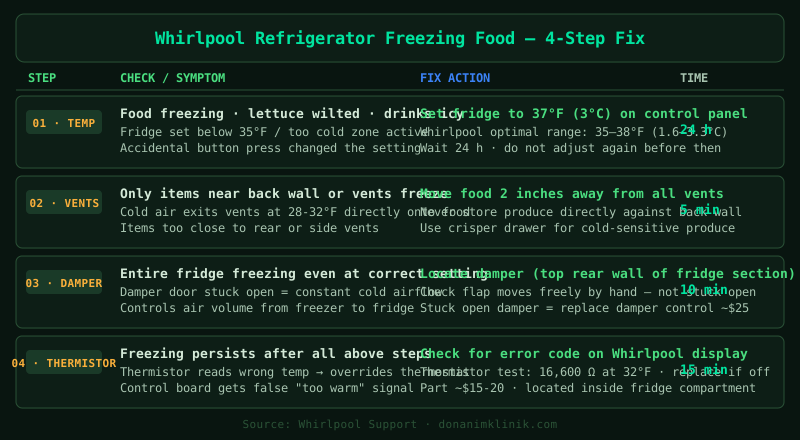
Set the refrigerator temperature to 37°F (3°C)
Whirlpool's recommended refrigerator temperature is 37°F (3°C). Settings below 35°F (-1.7°C) cause food near the air vents to freeze, especially produce and beverages. Check the temperature display or dial and confirm it is set to 37°F. If the dial uses a numbered scale (1 to 9 or similar), the midpoint setting is typically equivalent to 37°F — consult your model's use and care guide for the exact correspondence. After adjusting the temperature, keep the refrigerator door closed as much as possible for 24 hours to allow the interior to stabilize at the new setting. Verify the actual temperature with a refrigerator thermometer after 24 hours.
Move food away from the air vents
Cold air exits the rear and sometimes side vents of the Whirlpool refrigerator section at 28 to 32°F — well below freezing — before it mixes with the warmer air inside the compartment. Food placed directly against or within one inch of these vents will freeze regardless of the temperature setting. Locate the vent openings on the rear wall and side panels of the refrigerator section. Move any food stored directly against or near these vents at least 2 inches away. Produce, beverages, and leftovers are the most common items to freeze this way. Use the crisper drawers for items that are cold-sensitive.
Check and test the damper door
The damper door is a small flap or baffle located at the top rear of the refrigerator section, where cold air flows in from the freezer. It opens and closes to regulate how much cold air enters the refrigerator section. When the damper is stuck in the open position, cold air flows continuously into the refrigerator section at the freezer rate — causing the refrigerator to run far below the setpoint and freeze food throughout the compartment, not just near vents. Locate the damper (typically visible as a small rectangular opening at the top of the back wall, covered by a plastic housing). Open the refrigerator and listen for the damper to open and close — it should not be continuously open. If the damper is visibly stuck open or the housing is ice-covered, the damper assembly has failed. Contact an appliance technician to replace the damper control assembly — typical cost is $100 to $160 including parts and labor.
Test the refrigerator thermistor
The thermistor is a temperature sensor inside the refrigerator compartment that tells the control board the current temperature. A failed thermistor that reads artificially high (reporting a warmer temperature than actual) causes the control board to run the cooling system continuously, overcooling the refrigerator section. Check the Whirlpool display for error codes — a thermistor failure typically produces a specific fault code depending on the model (common codes: 6E, 22E, or an 'F' code). The thermistor is a small component clipped to the refrigerator compartment liner, usually near the top. It can be tested with a multimeter: at 32°F (0°C), a functioning thermistor reads approximately 16,600 ohms. A thermistor that reads significantly outside this range or shows an open circuit (OL) has failed. If the thermistor has failed, contact a Whirlpool-authorized technician — part and labor typically runs $120 to $180.