
Computer lagging on Windows 11 describes a pattern of brief freezes, stutters, delayed responses to mouse and keyboard input, or sustained sluggishness that interrupts normal use. Unlike a gradual overall slowdown, lag is episodic — the computer performs acceptably and then becomes briefly unresponsive before recovering. According to Microsoft’s official performance documentation, lag episodes are caused by resource saturation: one component — CPU, RAM, disk, or GPU — reaches 100% capacity and forces other operations to wait until it becomes available again.
What causes a computer to lag on Windows 11
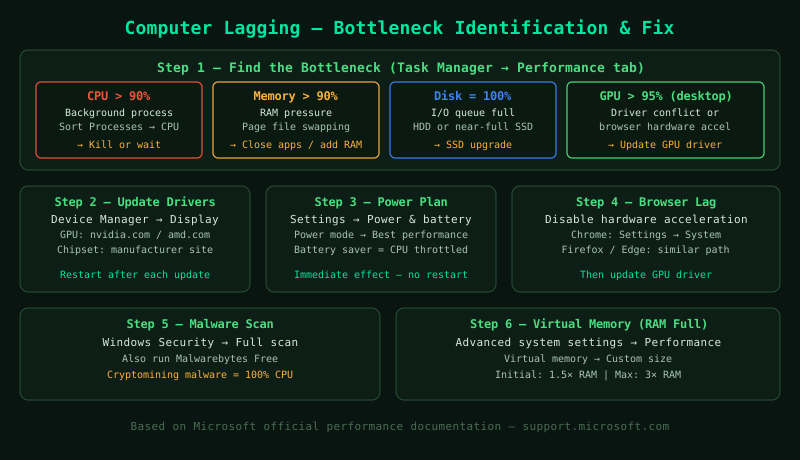
CPU saturation — A background process consuming sustained high CPU leaves insufficient processing capacity for foreground applications. The result is brief lag whenever the foreground app needs CPU cycles that are already committed to the background process. Common background causes: antivirus scans, Windows Update installation, and cryptocurrency mining malware.
RAM pressure — When all installed RAM is in use, Windows writes excess data to the page file on the storage drive. Because drive access is many times slower than RAM access, page file activity causes the characteristic 1–5 second freeze-and-recover lag pattern. On computers with 4 GB RAM, RAM pressure is frequent under normal multitasking conditions.
Disk I/O saturation — A spinning hard drive or a nearly full SSD that cannot keep up with read and write requests causes lag whenever an application or Windows needs to access storage. HDDs are especially prone to this because they can only read from one location at a time, and multiple processes queuing disk requests results in each waiting for the others.
Outdated GPU or chipset drivers — Drivers are the software that allows Windows to communicate with hardware components. Outdated GPU drivers cause visual stutter and lag during rendering. Outdated chipset drivers cause system-wide instability because the chipset manages data routing between the CPU, RAM, and storage — errors in this routing cause unpredictable lag.
Power plan throttling — On battery power, Windows throttles the CPU to reduce power consumption. On a laptop running on Power saver mode, the CPU may run at 30–50% of its maximum frequency, causing lag during any CPU-intensive task.
How to fix computer lagging on Windows 11
Start with step 1 to identify the specific bottleneck before applying other fixes. The correct fix depends on which resource is saturated.
How to verify the fix
After applying fixes, recreate the scenario that previously caused lag. Open Task Manager > Performance tab and observe all four graphs — CPU, Memory, Disk, and GPU — during the previously problematic activity. Sustained usage above 90% on any single resource indicates it is still the bottleneck. If no single resource consistently reaches 90%, the lag should be resolved or significantly reduced.
Known limitations
Lagging caused by insufficient RAM or an HDD has a software ceiling — while page file adjustments and startup program reduction reduce RAM pressure, adding physical RAM is the permanent solution for memory-related lag. Similarly, no driver or settings change makes an HDD perform like an SSD for random access patterns. On hardware that meets Windows 11’s minimum specifications but not its recommended specifications (i.e., exactly 4 GB RAM, minimum CPU), some lag is expected during multitasking and cannot be fully eliminated without hardware upgrades.