A deleted file on Windows is not immediately gone. Windows marks the disk space as available but leaves the data in place until new files are written there. This gives a recovery window that ranges from hours on an active system drive to weeks on an external drive used only for storage.
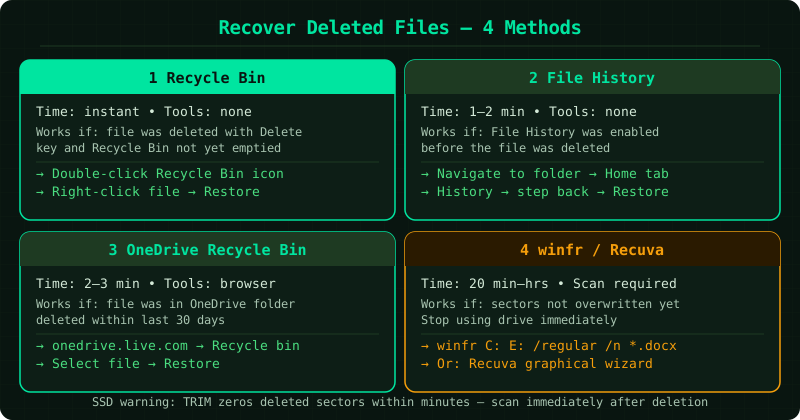
The four methods below work in order from quickest (no tools needed) to deepest (full disk scan). Work through them in sequence — each step takes only a few minutes to attempt.
Which deletions are recoverable — and which are not
Always recoverable: Files in the Recycle Bin (right-click → Restore). Files in OneDrive Recycle Bin within 30 days. Files covered by File History or Windows Backup.
Usually recoverable (if drive not heavily used since deletion): Files deleted with Delete key or Send to Recycle Bin, then Recycle Bin emptied. Files deleted with Shift+Delete. Files on external drives deleted without Recycle Bin routing.
Rarely recoverable: Files on SSDs where TRIM has executed (can happen within minutes). Files on drives that have been filled with new data since deletion. Files from reformatted drives that have been used extensively since formatting.
How to verify the fix
Open each recovered file and check its contents before closing the recovery application. A file that recovers successfully opens completely with all its data intact. A partially recovered file will open with some content missing or display an error message. Only move fully intact files to your permanent storage location. Discard files that show corruption and do not waste time trying to repair them — if the sectors were overwritten, the data cannot be reconstructed.
Stopping the clock on recovery chances
The single most important action after accidental deletion is to stop using the drive. Every file you save, every web page you visit, every application that writes to disk reduces the chance of recovery by potentially overwriting the deleted file’s sectors. If the file is on your C: drive and you cannot stop using the computer, at minimum avoid downloading files, installing software, or saving new documents until you have run the recovery scan.
Frequently Asked Questions
Can I recover a file deleted more than 30 days ago?
Possibly. The Recycle Bin holds files until it reaches its size limit or until you empty it — there is no fixed 30-day expiry for the Recycle Bin itself. For permanently deleted files, recovery depends on whether the disk sectors have been overwritten. On a drive that has had little new data written since the deletion, recovery may be possible weeks or months later. On an active system drive used daily, data can be overwritten within hours. Stop using the drive as soon as you notice the deletion and run a recovery scan immediately.
Files I deleted from a USB flash drive are not in the Recycle Bin — why?
Files deleted from USB flash drives, external drives under a certain size, and network locations bypass the Recycle Bin and are permanently deleted immediately. Windows does not route removable storage deletions through the Recycle Bin by default. To recover these files, use Windows File Recovery (winfr) or Recuva, scan the USB drive directly, and save recovered files to a different location.
I pressed Shift+Delete by accident — is the file gone forever?
Not necessarily. Shift+Delete permanently deletes the file and bypasses the Recycle Bin, but the data often remains on disk until overwritten. Stop using the drive immediately — every new file write reduces recovery chances. Run Windows File Recovery in Regular mode first: winfr C: D: /regular /n \path\to\filename. If Regular mode finds nothing, run Extensive mode. The sooner you run the scan, the higher the chance of recovery.
Can I recover a deleted file without installing any software?
Yes, if the file was in a folder covered by File History or if it was stored in a OneDrive-synced folder. Both methods restore files without any third-party tools. Windows File Recovery is also developed by Microsoft and available in the Microsoft Store (official). If none of these apply, a third-party scanner like Recuva is required.
Will recovery software recover my file in its original quality?
If the sectors containing the file data have not been overwritten, the recovered file is byte-for-byte identical to the original — full quality with no degradation. If the sectors were partially overwritten, the recovered file may be truncated, have corrupted sections, or fail to open entirely depending on how much of the original data remains. There is no middle state where a recovered file is lower quality but fully intact — it either recovers completely or shows corruption.