Old laptop running slowly on Windows 11 means a computer that performed acceptably when new but is now frustratingly slow for everyday tasks — web browsing, office applications, and video calls. According to Microsoft’s official performance documentation, older hardware running Windows 11 benefits most from removing software overhead and addressing storage bottlenecks, because the CPU and RAM requirements of Windows 11 have grown relative to when many older laptops were manufactured.
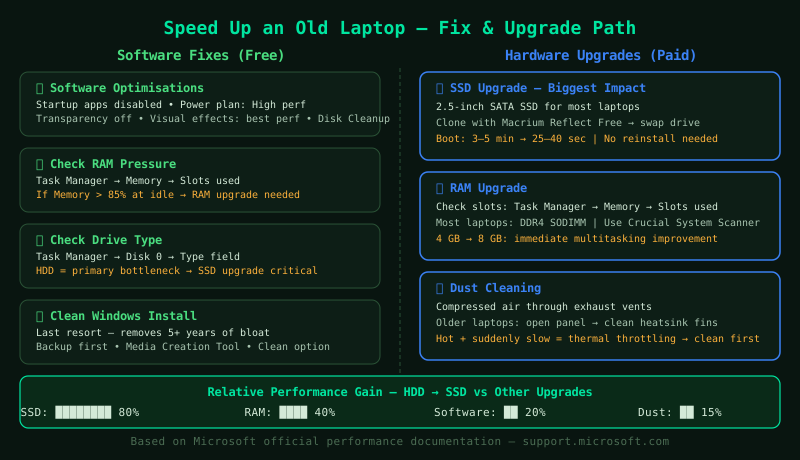
Why old laptops slow down on Windows 11
Storage bottleneck — Most laptops manufactured before 2018 shipped with spinning hard drives (HDDs). Windows 11, modern browsers, and current office suites generate significantly more random disk read/write activity than software from 2015–2018. An HDD’s random read performance has not improved, but software’s demands on storage have increased, creating a widening gap.
Insufficient RAM — 4 GB of RAM was adequate for Windows 7 and Windows 10 in 2015. Windows 11 consumes 2.5–3 GB at idle, leaving 1–1.5 GB for all running applications. Chrome with five tabs, a document editor, and a video call consume more RAM than a 4 GB system provides, forcing constant page file swapping.
Thermal throttling from accumulated dust — Cooling systems designed to handle the heat output of a 2015-era CPU may be clogged with years of dust, reducing airflow and causing the CPU to throttle its clock speed under load to prevent overheating.
Accumulated software bloat — Years of software installation, Windows updates, and background service additions compound over time, adding startup entries, background processes, and scheduled tasks that consume resources throughout each session.
How to speed up an old laptop
Apply software fixes first (step 1), then assess whether hardware upgrades are warranted based on what Task Manager shows as the bottleneck.
How to verify the fix
After software optimisations: Task Manager at idle should show Disk below 50%, Memory below 75%, and CPU below 10%. After an SSD upgrade: measure startup time from power button press to a responsive desktop — it should be under 45 seconds. Application launch times (browser, word processor) should feel immediate rather than requiring a wait.
Known limitations
An SSD and RAM upgrade cannot improve a CPU that is genuinely too slow for modern software. CPUs from 2013–2015 (Intel 4th and 5th generation, AMD APU equivalents) run Windows 11 and modern browsers at an acceptable rate for basic tasks but struggle with video calls, multiple browser tabs, and background tasks simultaneously. If Task Manager shows the CPU consistently above 80% during normal use even after other optimisations, the processor is the bottleneck and hardware upgrades to storage and RAM will not fully resolve the slowness. In this case, a replacement computer or switching to a lighter operating system is the more pragmatic solution.
Frequently Asked Questions
Is it worth upgrading an old laptop or should I just buy a new one?
The answer depends on the laptop's CPU generation. An Intel Core i5 or i7 from 2016 onward, or an AMD Ryzen processor from 2017 onward, with an SSD and 8 GB RAM, performs adequately for office work, video calls, and web browsing in 2026. Older CPUs (pre-2016 Intel Core i5/i7, pre-2017 AMD) may struggle even with hardware upgrades because the CPU is the bottleneck rather than storage or RAM. Check the processor model in Task Manager > Performance > CPU — search for it online to see benchmark scores and assess whether the CPU is the limiting factor.
How do I know what RAM my old laptop supports?
The safest way is to run Crucial's free System Scanner tool (available at crucial.com) — it scans the computer and shows exactly which RAM modules are compatible. Alternatively, search for your laptop's exact model number (printed on the bottom label) plus 'memory specifications' on the manufacturer's support website. The spec sheet shows maximum RAM capacity, supported speeds (e.g., DDR4-3200), and module type (SODIMM for laptops). Mismatched RAM — wrong speed or wrong generation — will either not work or run at a reduced speed.
Can I upgrade the RAM in a laptop that has soldered RAM?
Many thin and light laptops manufactured from 2020 onward have RAM soldered directly to the motherboard, which cannot be upgraded. Open Task Manager > Performance > Memory and check the Slots used field. If it shows 2 of 2 slots and both are in use, the RAM is almost certainly soldered (most laptops with removable RAM only use 1 of 2 slots for single-channel configurations). If upgrade is not possible, focus on SSD replacement and software optimisations — these still produce significant improvements even without a RAM upgrade.
Will upgrading to an SSD void the laptop warranty?
In most countries, consumer protection law prohibits manufacturers from voiding a warranty solely because the user performed a user-serviceable upgrade such as a RAM or storage replacement. In the EU and UK, this is codified in consumer rights legislation. In the US, the Magnuson-Moss Warranty Act provides similar protections. Check your laptop's service manual — most manufacturers include storage drive replacement as a user-serviceable operation. If the laptop is still under warranty and the drive bay is labelled as user-accessible, the upgrade will not void the warranty.
What is the best SSD brand for a laptop upgrade?
For 2.5-inch SATA SSDs, Samsung 870 EVO, Crucial MX500, and Western Digital Blue are consistently reliable options with strong performance and long warranty terms (3–5 years). For M.2 SATA or NVMe, Samsung 980, Western Digital SN770, and Crucial P3 Plus offer good performance at reasonable prices. Avoid no-name or extremely low-priced SSDs — SSD quality varies significantly and drive failure on a no-name SSD can result in data loss. Buy from established manufacturers with a verifiable warranty.