
Speeding up Windows 11 involves adjusting multiple system settings that Microsoft deliberately sets to favour visual polish and background convenience over raw performance. According to Microsoft’s official performance optimisation documentation, the most impactful settings are startup program management, power plan configuration, and visual effect reduction — each targeting a different resource (disk I/O, CPU frequency, and GPU/CPU rendering load respectively) that contributes to overall system responsiveness.
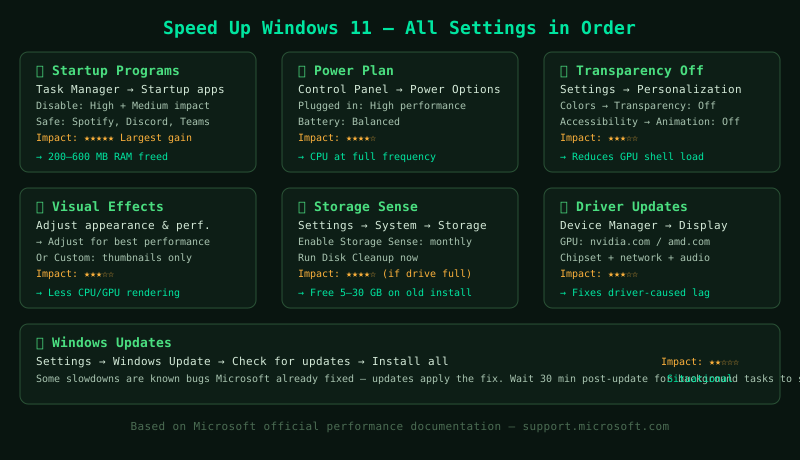
What limits Windows 11 performance by default
Startup program defaults — Software installers add startup entries by default. Most users never review or disable them. After months of use, the cumulative effect is a desktop that takes minutes to become fully responsive after login.
Power plan defaults — Windows 11 defaults to the Balanced power plan on both laptops and desktops. Balanced mode throttles CPU frequency when the system appears idle, which can delay the initial response to a user action by hundreds of milliseconds — enough to feel sluggish on slower CPUs.
Visual effects overhead — Windows 11’s default visual settings include transparency effects, animation on window open and close, and multiple layers of GPU compositing. On integrated graphics hardware, these effects consume a meaningful fraction of GPU capacity that would otherwise be available for application rendering.
Storage accumulation — Windows Update and application installers leave behind gigabytes of temporary files that accumulate over time. On drives already holding a large amount of data, the drive’s performance degrades further as free space shrinks.
How to speed up Windows 11
Apply the steps in order — earlier steps provide faster results. Step 1 (startup programs) and step 2 (power plan) together account for most of the performance improvement in a typical case.
How to verify the fix
After completing all steps and restarting, allow 5 minutes for Windows to settle. Open Task Manager > Performance and observe CPU, Memory, and Disk at idle. On a well-optimised Windows 11 system with 8 GB RAM, CPU should be below 5% at idle, Memory below 50%, and Disk below 10%. Open Task Manager > Startup apps and verify no High-impact entries remain enabled that are not essential.
Known limitations
These optimisations improve software efficiency but cannot change hardware capability. On computers with 4 GB RAM, RAM pressure remains a performance ceiling regardless of startup program configuration. On computers with HDDs rather than SSDs, disk access speeds remain the primary bottleneck for application launches and file operations. The settings in this guide represent the maximum performance extractable from Windows 11’s configuration options — beyond these settings, the next improvement comes from hardware upgrades: RAM to 8 GB or 16 GB, and HDD to SSD.