
Windows 11 running slowly means the system takes noticeably longer than before to open programs, respond to clicks, or complete file operations — and the slowness persists throughout the session rather than being limited to a specific application. According to Microsoft’s official performance documentation, the primary causes are startup programs that install themselves without asking permission, background applications consuming CPU and disk without a visible window, and visual effects that tax system resources on lower-end hardware.
What causes Windows 11 to run slowly
Startup program accumulation — Every piece of software that installs on Windows adds a startup entry unless the installer explicitly asks permission not to. Over months of use, a Windows 11 computer can accumulate 15–30 programs launching at login, collectively consuming significant RAM and disk I/O before the user opens a single application.
Background application activity — Applications that run in the background — cloud storage clients, communication tools, update agents, and telemetry services — compete with foreground applications for CPU cycles and disk read/write bandwidth. On computers with a spinning hard drive, this competition is especially damaging because the drive can only serve one request at a time.
Power plan throttling — The Power saver power plan, which is sometimes enabled automatically when a laptop’s battery drops below a threshold, limits CPU clock speed to reduce power consumption. A CPU running at 50% of its rated frequency makes the entire system feel sluggish even when performing simple tasks.
Disk space pressure — Windows 11 writes temporary files, virtual memory page files, and shadow copies continuously during operation. When the system drive is more than 85% full, Windows cannot allocate space for these operations efficiently, causing measurable slowdowns across all file-dependent operations.
Pending or in-progress Windows Updates — Windows Update downloads and installs updates in the background, consuming disk I/O and sometimes significant CPU time during the installation phase. The post-installation background tasks — component store optimisation, search index rebuilding — can persist for 30–90 minutes after a restart.
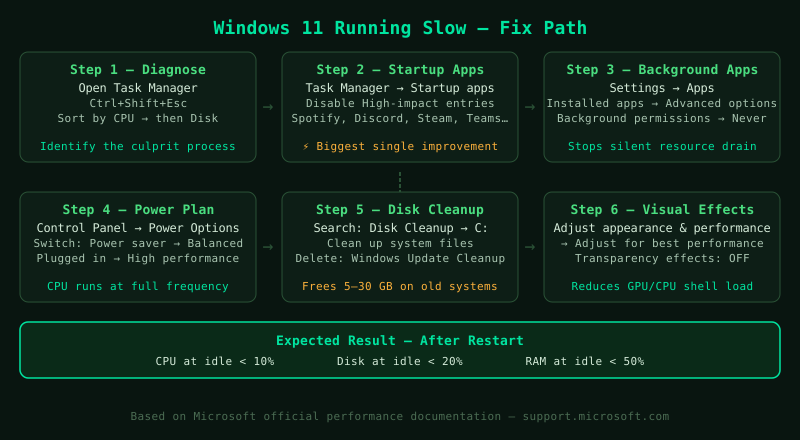
How to fix Windows 11 running slowly
Work through the steps in order. Steps 1 and 2 (Task Manager check and startup programs) provide the fastest measurable improvement for most users.
How to verify the fix
After completing the steps, restart the computer and allow 5 minutes for Windows to settle. Open Task Manager and check the CPU and Disk columns at idle — neither should sustain above 10% when no application is actively in use. Open a commonly used application and note the launch time. If startup was slow, measure the time from pressing the power button to a fully responsive desktop and compare with the time measured before the fixes.
Known limitations
These optimisations reduce software overhead but cannot compensate for insufficient hardware. On computers with 4 GB RAM, Windows 11 itself consumes most of the available memory, leaving little headroom for applications regardless of startup program configuration. On computers with a spinning hard drive rather than an SSD, file operation speeds remain fundamentally limited by the drive’s mechanical read/write speed — software optimisations reduce the number of file operations but cannot increase the drive’s maximum throughput. Upgrading RAM to 8 GB or replacing an HDD with an SSD produces a more significant performance improvement than any combination of software settings on under-resourced hardware.