
McAfee slowing down your computer means the system becomes noticeably sluggish after installing McAfee Total Protection — programs open slowly, file operations lag, startup takes longer, or Task Manager shows McAfee processes using sustained high CPU or disk. According to McAfee’s official support documentation, the primary driver of McAfee-related performance impact is the scan engine (mcshield.exe) competing for disk I/O with active applications, either through scheduled full scans running during working hours or real-time scanning of high-activity directories.
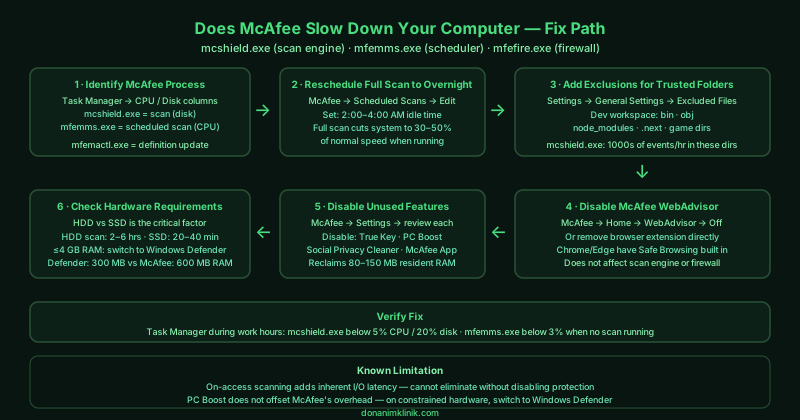
What causes McAfee to slow down your computer
Scan engine disk I/O during working hours — McAfee’s scheduled full-system scan (driven by mcshield.exe via mfemms.exe) reads every file on the primary drive sequentially. On spinning hard drives, this saturates the drive’s read throughput for the entire scan duration. On SSDs, it still competes with foreground application I/O and causes measurable latency. The scan’s timing is controlled by McAfee’s scheduler — if it runs during the day, the impact is directly felt.
Real-time scanning of high-activity directories — mcshield.exe intercepts every file read, write, and execute operation system-wide. Code compilation directories, download folders, game directories, and video editing working files can generate tens of thousands of file events per hour. McAfee scans each one, adding latency to every operation in those folders.
WebAdvisor browser overhead — McAfee WebAdvisor performs URL and page content inspection within the browser on every navigation. On pages with many third-party resources, WebAdvisor’s checks add perceptible loading delays.
Background feature services consuming resident memory — McAfee’s feature set beyond antivirus (True Key, PC Boost, Social Privacy Cleaner) all maintain background services that consume RAM even when not actively used, leaving less memory available for applications on systems near their RAM limit.
How to fix McAfee slowing down your computer
Work through the steps in order. Step 2 (rescheduling the full scan) and step 3 (adding exclusions) provide the most immediate improvement for most users.
How to verify the fix
After adjusting the scan schedule and adding exclusions, monitor Task Manager during normal working hours. mcshield.exe disk usage should stay below 5% outside of active scan periods. mfemms.exe CPU should remain below 3% when no scan is running. If startup is slow, compare the McAfee service startup times in Event Viewer (Windows Logs > System) before and after changes — look for entries from McAfee services to see their initialisation time.
Known limitations
Optimising McAfee’s scan schedule and exclusions reduces the performance impact but cannot eliminate it. McAfee’s real-time scan engine intercepts every file operation by design — this is the fundamental mechanism of on-access scanning and cannot be configured away without disabling real-time protection. On computers with 4 GB RAM or less, or with a spinning hard drive, McAfee’s baseline memory footprint leaves insufficient headroom for smooth multitasking. In these hardware configurations, switching to Windows Security (Windows Defender, built into Windows 11, no additional overhead) is a more effective performance solution than any McAfee configuration change. McAfee’s PC Boost feature — which claims to improve system performance — does not compensate for the overhead McAfee itself introduces; in practice it adds a background monitoring service without measurable user-facing benefit on systems already under resource pressure.