McAfee won’t uninstall on Windows 11 means the standard Windows uninstaller fails to remove McAfee, the uninstall process freezes or shows an error, or McAfee reappears after appearing to uninstall successfully. According to McAfee’s official support documentation, the standard Windows uninstaller is not designed to remove McAfee completely — McAfee’s architecture includes kernel-level drivers and protected service registrations that require the dedicated MCPR (McAfee Consumer Product Removal) tool to remove cleanly.
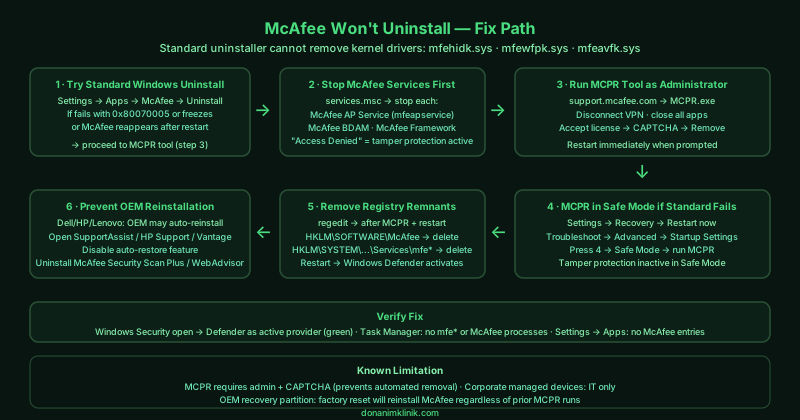
What causes McAfee not uninstalling on Windows 11
Tamper protection blocking removal — McAfee’s self-protection mechanism prevents its own processes, files, and registry entries from being modified or deleted by anything other than McAfee’s own authorised tools. This protection cannot distinguish between malicious removal (ransomware disabling antivirus) and legitimate user uninstalls, so it blocks both equally.
Kernel-level drivers that cannot be removed while running — McAfee installs network filter drivers (mfehidk.sys, mfewfpk.sys) and file system filter drivers (mfeavfk.sys) that load before Windows completes startup. These drivers cannot be unloaded while Windows is running — they can only be removed during the boot sequence, which is why MCPR works but the standard uninstaller does not.
OEM reinstallation mechanism — On Dell, HP, and Lenovo computers sold with McAfee pre-installed, the manufacturer’s software management layer monitors for McAfee’s removal and reinstalls it automatically. This explains cases where McAfee “comes back” after the user removes it.
Windows Security Centre registration conflict — After an incomplete uninstall, McAfee’s Security Centre registration persists, keeping Windows Defender disabled. Windows believes a third-party antivirus is still active even though the McAfee application is gone.
How to fix McAfee not uninstalling on Windows 11
Work through the steps in order. The MCPR tool (step 3) is the definitive fix — steps 1–2 are preparatory actions that improve MCPR’s chances of completing without errors.
How to verify the fix
After running MCPR and restarting, open Windows Security from the Start menu. It should open and show Windows Defender as the active protection provider with green status indicators. Verify no McAfee processes appear in Task Manager (sort by Name and check for any entries starting with ‘mfe’ or ‘McAfee’). Open Settings > Apps > Installed apps and search for McAfee — no results should appear.
Known limitations
MCPR requires administrator access and will not run under a standard user account. On corporate managed devices where the IT department controls software installation, MCPR may be blocked by endpoint management policies — only the IT department can remove McAfee from these devices. MCPR also requires completing a CAPTCHA verification, which prevents automated removal scripts from using it. On some OEM devices with deep factory restore integration (particularly entry-level Dell and HP laptops sold with a McAfee subscription bundled into the purchase price), McAfee may reinstall through the Windows Out-of-Box Experience recovery process even after MCPR removes it — in these cases, the OEM recovery partition must be modified or replaced, which voids the manufacturer’s recovery option.
Frequently Asked Questions
Why does McAfee keep reinstalling itself after I uninstall it?
McAfee reinstalling itself after removal on consumer laptops is almost always caused by the manufacturer's OEM agreement rather than McAfee itself. Dell, HP, and Lenovo include McAfee in their bloatware restoration systems — when the system detects McAfee has been removed, the OEM software management layer reinstalls it. The fix is to: (1) run MCPR to perform a deep removal, (2) uninstall all remaining McAfee components from Settings > Apps, and (3) disable the manufacturer's auto-restore feature in Dell SupportAssist, HP Support Assistant, or Lenovo Vantage. On some OEM devices, the McAfee trial is tied to the Windows recovery partition — a factory reset will reinstall McAfee regardless of prior MCPR runs.
Why is McAfee blocking its own uninstall on Windows 11?
McAfee includes a tamper protection mechanism — the same technology it uses to prevent malware from disabling it — that also prevents its own processes and registry entries from being modified by external tools, including the Windows uninstaller and some third-party removal tools. This is intentional: McAfee's tamper protection cannot distinguish between malicious removal attempts (by ransomware or rootkits) and legitimate user uninstalls. The MCPR tool is the only removal method McAfee officially supports — it has built-in bypass credentials for McAfee's own tamper protection. Running MCPR in Safe Mode adds a second layer of bypass by preventing McAfee's services from loading at all.
What does McAfee leave behind after a standard uninstall?
The standard Windows uninstaller removes McAfee's application files and Start menu entries but leaves behind: kernel-level drivers (mfehidk.sys, mfewfpk.sys, mfeavfk.sys, mfefirek.sys) registered in the Windows service database, registry entries under HKLM\SOFTWARE\McAfee and HKLM\SYSTEM\CurrentControlSet\Services\mfe*, Windows Security Center registration entries that tell Windows McAfee is managing antivirus, and sometimes the McAfee WebAdvisor browser extension. These remnants cause Windows Defender to remain disabled (because Windows still believes an antivirus is registered), and can block other antivirus installations that detect conflicting registrations.
Can I use a third-party uninstaller instead of MCPR?
Third-party uninstaller tools (such as Revo Uninstaller, IObit Uninstaller, or Geek Uninstaller) can remove McAfee's application files and most registry entries, but they cannot remove McAfee's kernel-level drivers — mfehidk.sys and mfewfpk.sys load at boot before Windows security checks allow external tools to remove them. MCPR is the only tool that removes McAfee's drivers cleanly because it runs its own driver removal routine during the Windows boot sequence. Using a third-party uninstaller followed by manual registry cleanup comes close but consistently leaves driver registrations that prevent other antivirus products from installing correctly.
After uninstalling McAfee, will Windows Defender turn on automatically?
Yes — after a complete McAfee removal using MCPR and a restart, Windows Defender activates automatically. Windows Security Centre monitors all registered antivirus products. When McAfee's registration is fully removed by MCPR, Windows detects the absence of a registered antivirus and enables Windows Defender within a few minutes of the next startup. If Windows Defender remains greyed out after MCPR and a restart, McAfee's Security Centre registration was not fully removed — run the registry cleanup step above (HKLM\SOFTWARE\McAfee and mfe* service entries) and restart again.