
Norton slowing down your computer means the system becomes noticeably sluggish after installing Norton 360 — startup takes longer, programs open slowly, file operations lag, or Task Manager shows Norton processes consuming sustained high CPU or disk usage. According to Norton’s official support documentation, the most impactful cause of Norton-related slowdowns is the scheduled full-system scan running during active use, combined with real-time scanning of high-activity folders that creates constant I/O competition with other applications.
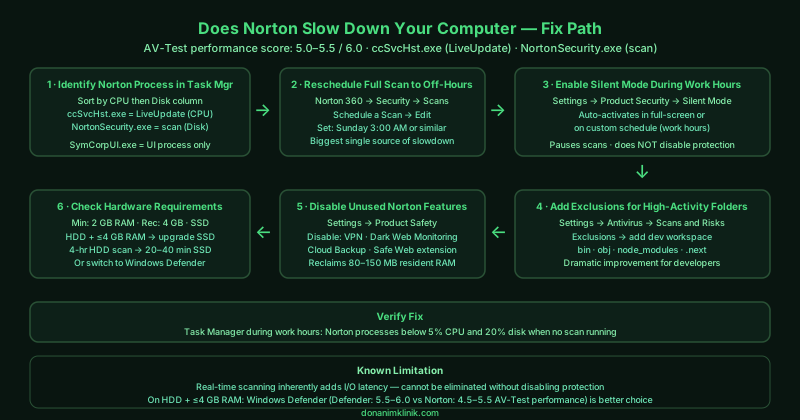
What causes Norton to slow down your computer
Full-system scan during working hours — Norton’s automatic full-system scan reads every file on the storage device sequentially. On a spinning hard drive, this fully saturates the drive’s read throughput for the duration of the scan (often 2–4 hours). Even on SSDs, the scan competes with active applications for I/O bandwidth, causing noticeable sluggishness during the scan window.
Real-time scanning of high-activity directories — Folders that see constant file creation, modification, and deletion — code compilers, download directories, game directories, video editing projects — are scanned by Norton’s real-time engine for every file operation. The cumulative overhead of thousands of scan events per hour creates measurable latency in affected applications.
Background LiveUpdate processes — Norton downloads and installs definition updates multiple times per day. The update installation process (ccSvcHst.exe) is CPU-intensive and competes with foreground applications. On slower processors, this can cause temporary but noticeable slowdowns lasting 1–3 minutes.
Feature-specific overhead — Norton 360 runs multiple background services beyond antivirus: the VPN daemon, Password Manager sync, Cloud Backup scheduler, and Dark Web Monitoring all consume memory and periodic CPU cycles even when not actively in use.
How to fix Norton slowing down your computer
Work through the steps in order. Step 2 (rescheduling the full scan) and step 3 (Silent Mode) provide the fastest improvement for most users.
How to verify the fix
After adjusting the scan schedule and exclusions, monitor CPU and disk usage in Task Manager during your normal work hours. Norton-related processes should remain below 5% CPU and below 20% disk during periods when no scan is actively running. If startup is slow, compare boot times before and after disabling the Smart Firewall startup entry in Task Manager’s Startup apps tab.
Known limitations
Optimising Norton’s settings reduces its performance impact but cannot eliminate it entirely — real-time scanning inherently adds latency to every file operation. On computers with 4 GB of RAM or less, or with a spinning hard drive rather than an SSD, Norton’s resource requirements leave insufficient headroom for smooth multitasking regardless of configuration. In these hardware configurations, switching to Windows Defender (built into Windows, no additional overhead) or Malwarebytes (on-demand scanner with no persistent background process beyond a lightweight service) is the more effective solution than optimising Norton. Norton’s official system requirements list 2 GB RAM as the minimum but do not account for the simultaneous memory demands of Windows 11, active applications, and Norton’s full feature suite.