QuickBooks Error 6123, 0 appears as: “Connection to the QuickBooks company file has been lost,” or when QuickBooks refuses to open the company file at all. The number pair — 6123 followed by 0 — identifies this specific connection failure. According to Intuit’s Error 6123 documentation, the most frequent cause is a hosting conflict: two or more computers on the network are both set to host the company file, and they block each other from establishing a clean connection.
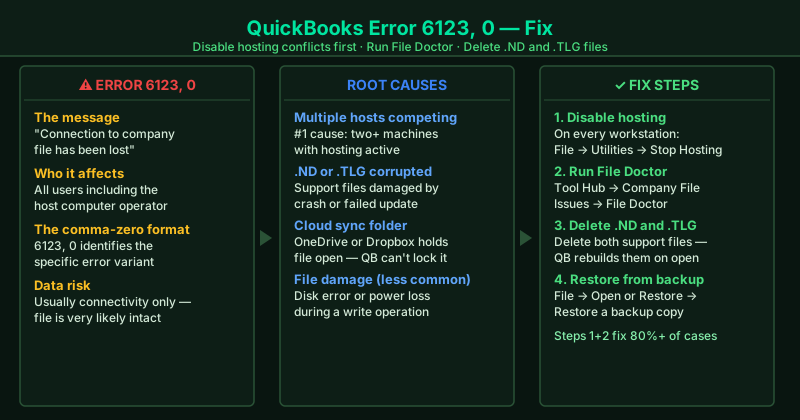
What causes QuickBooks Error 6123
Multiple computers hosting the company file — When more than one machine has QuickBooks multi-user hosting enabled, each tries to control access to the company file. The conflict breaks the connection and triggers Error 6123 for all users — including the one sitting at the correct host machine.
Corrupted .ND or .TLG support files — The .ND file stores the network path to the company file, and the .TLG file stores the transaction log. Corruption in either — from a crash, a failed update, or an abrupt shutdown — causes Error 6123 on the next open attempt.
Company file on a non-local or cloud-synced path — Storing the company file in a OneDrive, Dropbox, or Google Drive synced folder causes file locking conflicts. Cloud sync tools hold the file open while QuickBooks tries to do the same, breaking the connection.
Damaged company file — Severe cases of Error 6123 involve actual file corruption from a disk error, power loss during a write operation, or a failed QuickBooks update. File Doctor identifies these cases and recommends a restore.
How to fix QuickBooks Error 6123
Work through the steps in order. Step 1 and Step 2 together resolve over 80% of Error 6123 cases.
How to verify the fix
After each step, open QuickBooks and select your company file from the No Company Open screen or via File > Open or Restore Company. If QuickBooks opens the file without Error 6123, the fix worked. Once open, go to File > Back Up Company > Create Local Backup immediately to protect your data.
Frequently Asked Questions
What does QuickBooks Error 6123, 0 mean?
Error 6123, 0 means QuickBooks lost or cannot establish its connection to the company file. The comma-zero format (6123, 0) is QuickBooks's way of specifying the exact error variant. The connection breaks because of hosting conflicts between multiple computers, a corrupted .ND file, a damaged company file, or a network path change. The good news: Error 6123 most often means a connectivity problem, not file corruption.
QuickBooks Error 6123 appeared after a Windows update. What happened?
Windows updates can reset network share permissions, change Windows Firewall rules, or alter the registry entries that QuickBooks uses to find the company file. After a Windows update causes Error 6123, run File Doctor first — it re-establishes the network connection information. If that does not work, check that the company file folder's sharing permissions were not reset by the update (right-click the folder, select Properties > Sharing).
Is my QuickBooks data lost when Error 6123 appears?
Not necessarily. Error 6123 is usually a connection or network issue, not data destruction. Your company file is very likely intact. File Doctor can confirm whether the file is damaged. Even if the file has some damage, QuickBooks's Auto Data Recovery (ADR) feature automatically maintains a backup of your transaction log. Look for the .adr folder in the same location as your company file — it may contain a recent recoverable version.
How do I know which computer should be the host in multi-user mode?
The host should always be the computer that physically stores the company file on its local hard drive. That computer should be the only one with Host Multi-User Access turned on (File > Utilities > Host Multi-User Access). All other computers should show Stop Hosting Multi-User Access in the same menu, meaning hosting is active. A simple rule: if the company file lives on it, it hosts. If it does not store the file, it should not host.
Can I prevent Error 6123 from happening again?
To prevent recurring Error 6123: store the company file only on the host computer's local hard drive (never on USB drives or mapped network drives), keep QuickBooks updated to the latest release, create a local backup daily using File > Back Up Company > Create Local Backup, and after any Windows update, open Tool Hub and run the Network Issues scan to re-establish firewall rules for QuickBooks.