QuickBooks Online bank feed errors — from “Action required” prompts to a complete stop in transaction syncing — are almost always caused by an expired bank session token, a bank-side security change that requires re-authentication, or a broken integration between Intuit and your financial institution. According to Intuit’s bank feed documentation, clicking Update in the Banking section resolves the majority of sync errors.
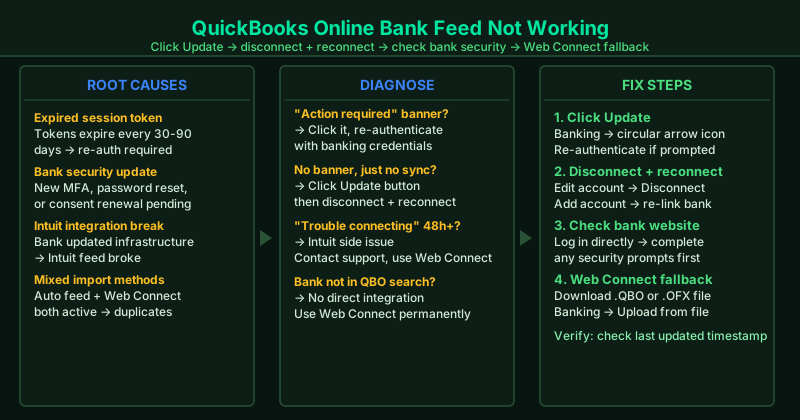
What causes QuickBooks Online bank feed errors
Expired session token — Bank feed connections use tokens that expire every 30 to 90 days depending on your bank. When a token expires, QBO loses the ability to pull transactions automatically and shows an authentication prompt.
Bank-side security update — Banks frequently add new security requirements — new MFA steps, mandatory password resets, or data-sharing consent renewals. When these are pending, QBO cannot connect using the previously saved credentials.
Intuit-bank integration break — Intuit maintains a direct data connection with each supported bank. When a bank updates its infrastructure, Intuit’s integration can break temporarily until Intuit’s banking team repairs it.
Mixed import methods — Using both the automatic bank feed and manual Web Connect import simultaneously causes the same transactions to appear twice in QBO.
How to fix QuickBooks Online bank feed errors
Work through the steps in order. The Update button (Step 1) resolves most feed errors caused by expired tokens and takes under one minute.
How to verify the fix
After reconnecting, go to QBO Banking and check that the last updated timestamp next to your bank account has refreshed to today’s date. Click into the For review tab and confirm that recent transactions from the past 24 hours are visible. If they appear, the bank feed is working again.
Frequently Asked Questions
Why does the QuickBooks Online bank feed stop syncing after a few weeks?
Bank feed connections use a session token that expires periodically — typically every 30 to 90 days depending on your bank's security policy. When the token expires, QBO can no longer pull transactions and shows an 'Action required' prompt in the Banking section. Click the prompt, re-enter your banking login credentials, and complete any multi-factor authentication step. This refreshes the token and restores automatic daily syncing.
QuickBooks Online bank feed shows duplicate transactions. How do I remove them?
Duplicate transactions appear when you manually upload a Web Connect file while the automatic bank feed is also active — QBO imports the same transactions from two sources. To remove duplicates: in the Banking section, go to the For review tab, select the duplicate entries, and click Exclude. Excluded transactions are hidden but not permanently deleted. Going forward, use only one import method at a time.
My bank is not listed in QuickBooks Online's bank connection search.
If your bank does not appear in QBO's bank search, it does not have a direct live feed integration with Intuit. Use Web Connect as a permanent alternative: download a .QBO or .OFX file from your bank's account history page and upload it in QBO under Banking > Upload from file. Most banks — including small credit unions and community banks — support OFX or CSV export even without a live feed integration.
The bank feed connected before but stopped importing new transactions. Old ones appeared fine.
When a previously working feed stops importing new transactions, the most likely cause is an expired authentication token or a bank-side change that broke the connection. In QBO Banking, check for an 'Action required' or 'Needs attention' banner next to your bank account. If no banner appears, disconnect and reconnect the account manually. Some banks also require annual renewal of third-party app data-sharing permission — check your bank's app permissions page for any pending renewals.
Web Connect file upload fails with 'No new transactions found.' Why?
This message means the date range of the file you uploaded overlaps entirely with transactions already imported into QBO — there is nothing new for QBO to add. Adjust the export date range in your bank's website to cover only the period after your most recent successful import. If you are unsure of the last import date, check the most recent transaction in the QBO Banking section and export from the day after that date.