Zoom can’t connect — showing “Unable to connect to Zoom,” dropping from meetings, or displaying persistent “connection unstable” warnings — is most commonly caused by a firewall rule blocking Zoom’s required ports, a VPN routing Zoom traffic through a server that restricts media connections, or a corporate network proxy intercepting Zoom’s HTTPS connections. According to Zoom’s official connectivity troubleshooting guide, testing on a mobile hotspot is the fastest way to determine whether the problem is local network configuration or a Zoom service issue.
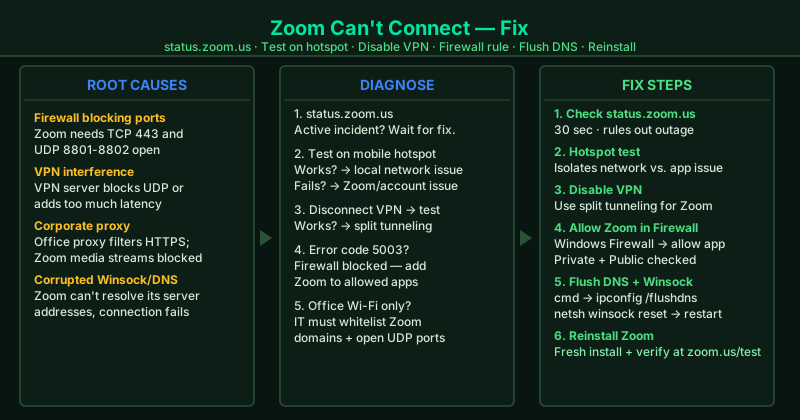
What causes Zoom to fail to connect
Firewall blocking Zoom’s ports — Zoom uses TCP port 443 for signaling and UDP ports 8801-8802 for media transmission. Windows Firewall or a third-party firewall blocking these ports produces “Unable to connect” errors that look identical to a Zoom outage.
VPN interference — VPN services route all traffic through a VPN server. When the VPN server is in a different region, adds latency, or blocks UDP traffic, Zoom’s media streams cannot be transmitted — causing connection failures or extreme instability during meetings.
Corporate network proxy — Office networks frequently route traffic through a web proxy that authenticates users and filters content. Zoom’s real-time media connections (WebRTC and UDP streams) are often incompatible with proxy configurations, causing Zoom to connect initially but fail to transmit audio and video.
Corrupted Winsock or DNS cache — A corrupted Windows network stack (Winsock) or stale DNS entries prevent Zoom from resolving and connecting to its server addresses. Other websites may appear to work normally while Zoom-specific connections fail.
Zoom installation corruption — A Zoom update that was interrupted, a partial installation, or corrupted Zoom files can cause persistent connection failures that cannot be resolved by changing settings. Reinstalling Zoom restores the correct binaries and connection certificates.
How to fix Zoom can’t connect
Work through the steps in order. Steps 1 and 2 take under three minutes combined and determine whether the problem is with Zoom’s infrastructure or your local network — this distinction determines whether any further troubleshooting is necessary.
How to verify the fix
Join the Zoom test meeting at zoom.us/test. The test meeting verifies your connection end-to-end, including media server connectivity. If the test meeting connects successfully and audio/video work correctly, your Zoom connectivity is fully restored.
Frequently Asked Questions
Zoom connects at home but not at the office — why?
Corporate networks frequently use firewalls, web proxies, and content filters that block Zoom's communication ports. Zoom requires TCP port 443 and UDP ports 8801-8802 to be open. Ask your IT department to whitelist Zoom's domains: *.zoom.us, *.zoomgov.com, and *.zoomcdn.net. If your corporate firewall blocks all UDP traffic, Zoom can fall back to TCP-only mode — enable this in Zoom Settings > Advanced by checking 'Force TCP connection for Zoom meetings.'
Zoom joins the meeting but disconnects after 30-60 seconds.
Repeated disconnections after joining indicate a network stability problem rather than a firewall block. Your connection is stable enough to join but not stable enough to maintain Zoom's real-time media stream. Check your router logs for packet loss or interference. If on Wi-Fi, try a wired Ethernet connection. Also check for other bandwidth-heavy applications — large file downloads, video streaming, or cloud backup running in the background — and pause them during the meeting.
Zoom shows 'Your connection is unstable' throughout the entire meeting.
Zoom requires at least 1.5 Mbps upload and download for stable HD video. Run a speed test at fast.com or speedtest.net during the unstable Zoom meeting. If your speed is below 1.5 Mbps or if packet loss exceeds 5%, your internet connection is the limiting factor. Move closer to your Wi-Fi router or connect via Ethernet. Close all other applications consuming bandwidth. If the instability is location-specific (only in certain rooms), the issue is Wi-Fi signal strength.
Zoom worked yesterday but shows 'Unable to connect' today — nothing changed.
When nothing changed locally, first check status.zoom.us for an active incident. If no incident is listed, your ISP may have routing issues affecting Zoom's servers. Run tracert zoom.us in Command Prompt to see where the connection is failing. Also check whether a security software update overnight added a new firewall rule or a new camera/microphone blocking policy. Temporarily disabling your antivirus and testing Zoom confirms or rules out a new security software rule.
Zoom error 5003 — what does it mean?
Zoom error 5003 means your computer cannot reach Zoom's servers. The cause is almost always a firewall rule, antivirus blocking, or a corporate proxy. Verify that Zoom.exe is allowed in Windows Firewall (Step 4). Check your antivirus for a 'network shield' or 'intrusion protection' feature that may be blocking Zoom's ports. On corporate networks, ask IT to confirm UDP port 8801-8802 are open. Error 5003 specifically indicates an outbound connection failure — not a Zoom server outage.