
External hard drive not showing up means you connect a portable hard drive to your computer and it does not appear in File Explorer, even though the drive spins up or its activity light comes on. The drive may be completely invisible, or it may appear in Disk Management without being accessible. According to Microsoft’s storage troubleshooting documentation, the most common causes are a missing drive letter, an uninitialised disk, a faulty USB cable, or a driver problem.
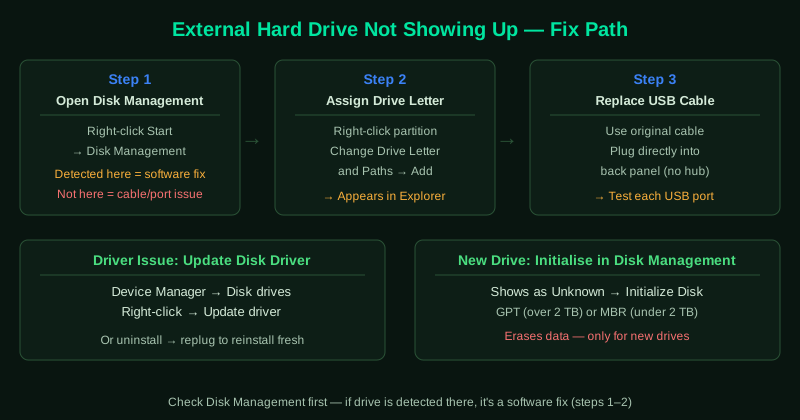
What causes an external hard drive not to show up
No drive letter assigned — Windows assigns each storage device a letter (E:, F:, G:, etc.) to make it accessible in File Explorer. If the letter was lost or conflicts with another device, the drive exists in Disk Management but is invisible in File Explorer.
Uninitialised disk — New external hard drives shipped without partitions need to be initialised and formatted before Windows can use them. Until initialised, they appear in Disk Management as Unknown.
Insufficient power — Bus-powered external hard drives require up to 900 mA from a USB 3.0 port. USB hubs, front panel ports, and laptops in power-saving mode may deliver less, causing the drive to fail to spin up fully.
Faulty USB cable — A cable with broken internal wires can pass enough current to power the drive’s indicator light while failing to maintain a stable data connection.
Corrupted or missing disk driver — The operating system driver for the external hard drive’s USB bridge chip can become corrupted after an abrupt removal or a failed Windows update.
How to fix external hard drive not showing up
Work through the steps in order. Steps 1 and 2 resolve most cases when the drive has been working before and stopped unexpectedly.
How to verify the fix
After each step, unplug the drive, wait 10 seconds, and reconnect it.
Known limitations
Microsoft’s official documentation does not address drives that use hardware encryption (such as Western Digital My Passport with WD Security). These drives require the manufacturer’s unlocking software before Windows can assign them a drive letter — Disk Management will show them as unallocated even after correct drive letter assignment attempts. Additionally, bus-powered external drives with failing USB bridge chips will appear and disappear intermittently in a way that mimics cable or port faults but cannot be resolved by any software fix — the enclosure needs replacement. If the drive appears in File Explorer with the correct capacity and you can browse its files, the fix worked. If the drive appears but shows errors when you open files, run CHKDSK from Command Prompt: chkdsk X: /f /r (replace X with the drive letter). If the drive makes unusual sounds — clicking, grinding, or repeated spinning — see Seagate External Hard Drive Not Working — Fix or consult a data recovery specialist.