Microsoft Teams screen share not working — whether the Share button is grayed out, participants see a black screen, or the sharing session crashes immediately — is most commonly caused by GPU hardware acceleration conflicting with Teams’ screen capture engine, an outdated display driver, or missing presenter permissions in the meeting. According to Microsoft’s Teams troubleshooting documentation, switching from Desktop sharing to Window sharing immediately identifies whether the issue is a permission or driver problem specific to full-desktop capture.
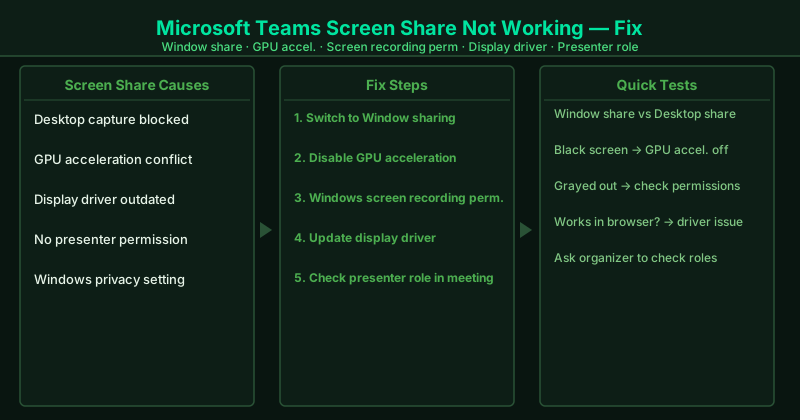
What causes Teams screen share to stop working
GPU hardware acceleration conflict — Teams uses GPU acceleration to render its interface efficiently. However, this same GPU pipeline occasionally interferes with the screen capture engine, producing a black screen for other participants when you attempt to share your desktop. Disabling GPU acceleration forces Teams to use a software-only rendering path that is fully compatible with all screen capture methods.
Outdated or incompatible display driver — Teams’ screen share relies on DirectX capture APIs that communicate directly with your GPU driver. After a Windows Update, a Teams update, or a GPU driver update, version mismatches between these components cause screen share to produce black screens or fail silently. Updating the display driver to the current version resolves the vast majority of post-update screen share failures.
Windows screen recording permission — Windows 11 introduced granular privacy controls for screen recording. If Teams does not have permission to capture the screen in Settings > Privacy & Security > Screenshots and screen recording, every screen share attempt shows a black screen to participants — with no error message visible to the presenter.
Missing presenter permission — Microsoft Teams meetings have role-based controls. Attendees cannot share their screen; only presenters and organizers can. When the organizer has set “Who can present” to a restrictive option, participants without the presenter role see the Share button grayed out.
DRM content protection — Windows applies hardware-level DRM protection to content from streaming services. When DRM-protected video is playing on screen, Teams’ capture API receives a black frame instead of the actual content. This is intentional operating system behavior, not a Teams bug.
How to fix Teams screen share not working
Work through the steps in order. Step 1 takes under 60 seconds and immediately identifies the category of failure — if Window sharing works but Desktop sharing does not, the remaining steps narrow down the specific cause.
How to verify the fix
In a Teams test meeting, click Share content and share your entire Desktop. Ask another participant to confirm they can see your screen and that it is updating in real time as you move windows. Then share a specific Window and confirm that also works. Check that the Share content button is not grayed out before attempting either test.
Frequently Asked Questions
Teams screen share shows a black screen to other participants.
A black screen during Teams screen share is almost always caused by one of three things: GPU hardware acceleration conflicting with the screen capture pipeline, a display driver that is outdated or incompatible with Teams' capture method, or Windows DRM (Digital Rights Management) protection on the content being shared. Disable GPU hardware acceleration in Teams Settings > General first (Step 2). If the black screen persists, update or reinstall your display driver. Note that DRM-protected content — such as Netflix, Disney+, or any streaming video playing in a browser — intentionally shows as black when captured by screen share tools.
The Share content button is grayed out in Teams.
A grayed-out Share content button means Teams is preventing screen sharing — either due to meeting permissions or a policy restriction. First, confirm you have presenter rights in the meeting by asking the organizer to check Meeting options > Who can present. If the Share button is grayed out in all Teams meetings, your organization's IT administrator may have disabled screen sharing via a Teams meeting policy in the Microsoft Teams admin center. Contact your IT department to confirm whether screen sharing is enabled for your account.
Teams screen share works on one monitor but not the other.
When screen share works on one monitor but produces a black screen on another, the second monitor is likely connected via a different output type — such as HDMI versus DisplayPort — or is running at a different refresh rate or color depth. In Teams' Share content dialog, try selecting the specific monitor by name. Also update your GPU driver, as multi-monitor screen capture issues are frequently resolved by driver updates. If the second monitor is connected through a docking station or USB-C adapter, try connecting it directly to the GPU.
Screen share was working and stopped after a Teams update.
Teams updates occasionally change the screen capture API used for desktop sharing, which can break compatibility with certain display driver versions. After a Teams update breaks screen sharing, first try disabling GPU hardware acceleration in Teams Settings > General. If that does not help, update your GPU driver to the latest version — driver updates released after a Teams update typically resolve these API incompatibilities within a few weeks of the Teams release.
Other participants can hear me but can't see my shared screen.
When audio works but the shared screen is invisible to others (they see a black screen or nothing at all), the problem is specific to the video capture path. This is the classic symptom of GPU hardware acceleration conflicting with Teams' screen capture, or a display driver issue. Disable GPU acceleration in Teams Settings > General (Step 2) and retest. Also try switching from Desktop sharing to Window sharing, as these use different capture methods. If participants see a frozen first frame rather than a black screen, the issue is network bandwidth — your upload speed may be insufficient to transmit the screen share stream.