Microsoft Teams won’t open — clicking the icon and seeing nothing happen, or watching Teams flash briefly then disappear — is most commonly caused by a stuck Teams background process left over from a previous crash, or a corrupted local cache that prevents the application from initializing. According to Microsoft’s official Teams troubleshooting documentation, ending all Teams processes in Task Manager and restarting the app resolves the majority of Teams launch failures.
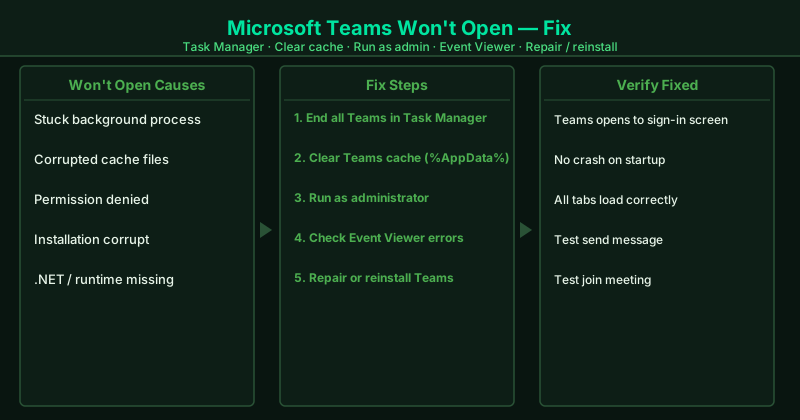
What causes Microsoft Teams not to open
Stuck background process — When Teams crashes or is closed abruptly, a Teams process can remain running in the background. This orphaned process holds file locks and port bindings that prevent a new Teams instance from starting. The new launch attempt silently fails because the system considers Teams already running.
Corrupted cache files — Teams stores a significant amount of cached data in %AppData%\Microsoft\Teams, including cached UI assets, authentication tokens, and database files. When these files become corrupted — due to an interrupted update, a disk write error, or an abrupt shutdown — Teams fails to read the cache on startup and crashes before displaying anything.
Insufficient permissions — In corporate environments, Teams may be installed with specific permission requirements. If your user account has restricted permissions due to a group policy change or a Windows Update that reset security settings, Teams may be blocked from accessing the files and network resources it needs to start.
Missing runtime components — Teams requires the .NET runtime and specific Visual C++ Redistributable packages to function. If these components are missing, corrupted, or at an incompatible version — which can happen after a system update or a partial installation — Teams fails at startup with no visible error to the user.
Corrupted installation — Teams update files are downloaded and applied automatically. A failed or interrupted update can leave Teams in a partially updated state where some files are at the new version and others are at the old version — producing startup crashes that neither cache clearing nor process killing can resolve.
How to fix Microsoft Teams not opening
Work through the steps in order. Step 1 takes under 60 seconds and resolves the large majority of Teams launch failures caused by stuck processes.
How to verify the fix
Teams should open to the sign-in screen or directly to your Teams workspace without crashing or showing a blank screen. Confirm all main tabs load correctly — Activity, Chat, Teams, Calendar, and Files. Send a test chat message and join a test meeting to confirm full functionality is restored.
Frequently Asked Questions
Teams icon bounces or flashes briefly then disappears without opening.
A brief flash on launch almost always indicates Teams crashed immediately after starting. The most common causes are a corrupted cache file that Teams tries to read on startup and a missing Visual C++ Redistributable that Teams depends on. Start with Step 2 — clear the Teams cache folders in %AppData%\Microsoft\Teams. If the flash persists, open Event Viewer > Windows Logs > Application and look for error entries at the exact time you attempted to open Teams. The error code or description will identify the missing component.
Teams was working after a Windows restart but no longer opens after sleep/wake.
Sleep and wake cycles can leave Teams processes in a zombie state — running in the background but unable to respond — which blocks new launches. Press Ctrl+Shift+Esc, find all Teams-related processes on the Processes tab, and end them. Then relaunch Teams from the Start menu. If this happens repeatedly after every sleep cycle, it indicates a conflict with Windows Fast Startup. Go to Control Panel > Power Options > Choose what the power buttons do > Turn off fast startup and test whether the problem continues.
Teams says 'This app can't run on your PC' when I try to open it.
'This app can't run on your PC' means your Windows installation is incompatible with the Teams executable you are trying to run — typically because the 32-bit version of Teams was installed on a 64-bit system or the Teams executable is from an incompatible release. Uninstall Teams completely, download the current Teams installer from teams.microsoft.com (select the correct architecture for your PC — most modern PCs should use the 64-bit version), and reinstall.
Teams opens to a white or blank screen and then closes.
A white or blank screen before closing indicates Teams launched but its rendering engine failed to display the interface — usually caused by GPU hardware acceleration conflicting with your display driver. Close Teams if still running. Rename or delete the file %AppData%\Microsoft\Teams\desktop-config.json — Teams will regenerate it with default settings on the next launch, including disabling problematic GPU settings. If Teams opens correctly after deleting this file, the configuration was corrupted.
I uninstalled and reinstalled Teams but it still won't open.
A standard uninstall often leaves residual files and registry entries that affect the fresh installation. After uninstalling Teams, manually delete %AppData%\Microsoft\Teams and %LocalAppData%\Microsoft\Teams before reinstalling. Also check %LocalAppData%\Microsoft\TeamsMeetingAddin for leftover files. If Teams is deployed through your organization's Microsoft 365 tenant via Endpoint Manager, reinstalling the consumer version will not work — contact your IT department to redeploy Teams through the management portal.