Open Control Panel → Backup and Restore (Windows 7) → Create a system image, connect an external hard drive with enough free space, and Windows creates a complete backup of your system drive — restore it from Windows Advanced Startup Options if your drive fails or Windows becomes unbootable.
A Windows system image backup is a complete copy of your entire drive — Windows, installed programs, settings, and personal files — saved to an external hard drive. If your system drive fails, Windows becomes unbootable, or a major problem cannot be fixed any other way, you restore from the image and your PC returns to exactly the state it was in when the backup was made.
System Restore protects against software changes but uses restore points stored on the same drive. A system image backup protects against hardware failure by keeping a complete copy on a separate device.
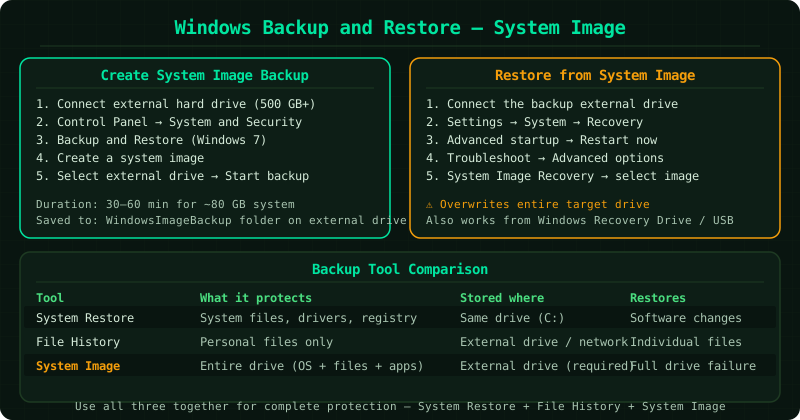
System image vs File History vs System Restore
| Tool |
Protects |
Where stored |
Restore scope |
| System Restore |
System files, registry, programs |
Same drive |
Roll back software changes |
| File History |
Personal files only |
External drive or network |
Individual file versions |
| System Image |
Entire drive |
External drive |
Full system recovery |
For recovering accidentally deleted files (not a full system restore), see the File Recovery Windows guides — they cover the Recycle Bin, File History, and sector-level scanning.
How to verify the fix
After the backup completes, open File Explorer and navigate to the external drive. You should see a folder named WindowsImageBackup containing a subfolder with your computer name. This confirms the backup was saved correctly. To test the restore process without actually restoring, boot from a recovery drive and browse to the System Image Recovery option — you can verify the image is detected and confirm its date without completing the restore.
Frequently Asked Questions
What is the difference between a system image and File History?
A system image is a complete snapshot of your entire drive — Windows, programs, settings, and personal files — saved at a single point in time. It restores everything at once but requires a full overwrite of the target drive. File History backs up only personal files (documents, photos, music, etc.) continuously every hour. System images protect against drive failure and OS corruption; File History protects against accidental file deletion and overwrites. Using both together provides complete protection.
Can I restore individual files from a system image?
Not directly through the System Image Recovery tool — it restores the entire drive as a unit. However, if you connect the external drive containing the system image to a working PC, you can browse the backup files using third-party tools, or mount the VHD file (the image format Windows uses) in File Explorer to access individual files. The image file is stored in the WindowsImageBackup folder on the external drive.
How often should I create a system image backup?
Create a new system image before major changes: upgrading Windows, replacing hardware, or installing significant software. For routine ongoing protection, rely on File History for personal files. If you use your PC for work and cannot afford extended downtime, a monthly system image is a reasonable schedule. Each new system image is saved as a separate backup — older ones are kept until you manually delete them or disk space runs out.
How much storage space does a Windows system image need?
The system image size equals the amount of used space on the drives being backed up, not the total drive capacity. A Windows installation with typical programs uses 50 to 150 GB. The external drive needs at least this much free space, plus additional room for growth. A 1 TB external drive is sufficient for most home users keeping one or two system image backups alongside File History data.
Does Windows 11 support the Backup and Restore tool?
Yes. Despite being labelled 'Backup and Restore (Windows 7)', the tool is fully supported in both Windows 10 and Windows 11 and creates complete, restorable system image backups. Microsoft has not removed or replaced it in Windows 11. Access it through Control Panel → System and Security → Backup and Restore (Windows 7).